
TACKLING TALENT SHORTAGE WITH 'FRANCHISE-BASED' MODEL
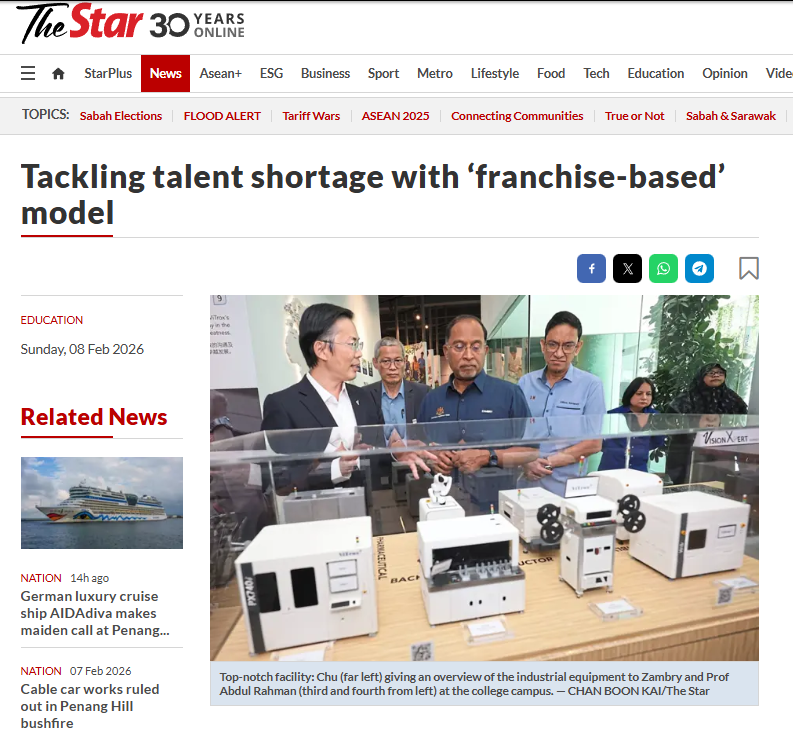
USM to award degrees for work-based learning at industrial campus
Higher education must move beyond static campus-based learning and adapt to an artificial intelligence (AI)-native world, says Datuk Seri Dr Zambry Abd Kadir.
“We are living in a new world, the world of AI. We are no longer just global citizens – we are now AI natives or AI citizens, and so the concept of education must change,” the Higher Education Minister said before witnessing the exchange of a memorandum of agreement between Universiti Sains Malaysia (USM) and ViTrox College in Batu Kawan, Penang, on Jan 28.
USM vice-chancellor Prof Datuk Seri Dr Abdul Rahman Mohamed said under this partnership, ViTrox College, a subsidiary of ViTrox Corporation Berhad, will deliver two USM-accredited undergraduate programmes, namely, the Bachelor of Electronic Engineering (Honours) and the Bachelor of Computer Science (Intelligent Computing) (Honours) through a franchise-based collaboration.
USM, he added, will retain full responsibility for academic governance, quality assurance and the awarding of degrees.
All student admission requirements, curriculum design, faculty appointments and assessment processes will strictly adhere to the varsity’s established quality assurance frameworks, he said.
“Day-to-day teaching and learning will take place at ViTrox College, which is within ViTrox Corporation’s operational industrial environment.
“This allows students to benefit from continuous exposure to real-world industrial practices, technologies, and problem-solving environments throughout their studies.
“A key advantage of this collaboration is the production of industry-ready graduates who can be seamlessly absorbed into the semiconductor workforce upon graduation.
“By bringing together USM’s academic strengths and ViTrox’s industrial capabilities, this will create a revolutionary learning model that is deeply relevant to today’s technological landscape,” he said, adding that the collaboration prioritises human capital development, innovation-led growth, and leadership in strategic technologies such as semiconductors and AI.
Prof Abdul Rahman noted that while the semiconductor industry in Malaysia, especially in Penang, is booming, it currently faces a severe shortage of talent.
Malaysia needs 60,000 skilled engineers in its semiconductor sector, but universities produce some 6,000 fresh engineers locally each year, he said.
Local universities such as USM, he added, face constraints in producing more talent in this field, particularly in terms of teaching manpower, specialised facilities and industry-grade infrastructure.
“Through this strategic collaboration, these limitations can be effectively addressed.
“This collaboration is projected to supply more than 1,500 skilled local professionals to the workforce over the next seven years, contributing directly to Malaysia’s semiconductor ecosystem, particularly in Penang,” he said, while welcoming suitable industrial partners from other fields to collaborate with USM in replicating the concept.
ViTrox president and group chief executive officer Datuk Chu Jenn Weng said the collaboration – dubbed the country’s first-ever public university degree programme hosted entirely within a global technology industrial campus – addresses long-standing challenges in talent development by embedding education directly within industry settings.
“By bringing the university into the industry, we solve the two biggest challenges in talent development: specialised facility costs and the academic-industrial skills gap.
“Our work-based learning model uses the factory floor as a living classroom, guided by a unique mentor model comprising academy, industry and life skills that ensures our students are not only technically proficient but also grounded in character,” he said.
Zambry said the collaboration reflected a shift under the new Malaysia Higher Education Blueprint 2026 -2035 towards what he described as the “unbundling” of education, where learning is no longer confined to physical campuses but integrated with industry and applied in real-world settings.
He emphasised that applied knowledge, particularly in areas such as engineering, AI and semiconductors, should not be constrained within campus.
The USM-ViTrox partnership, Zambry said, should serve as a showcase for other universities and industries, noting that Penang and Malaysia have emerged over the past decade as a significant global hub for semiconductor research and development.
Source: The Star